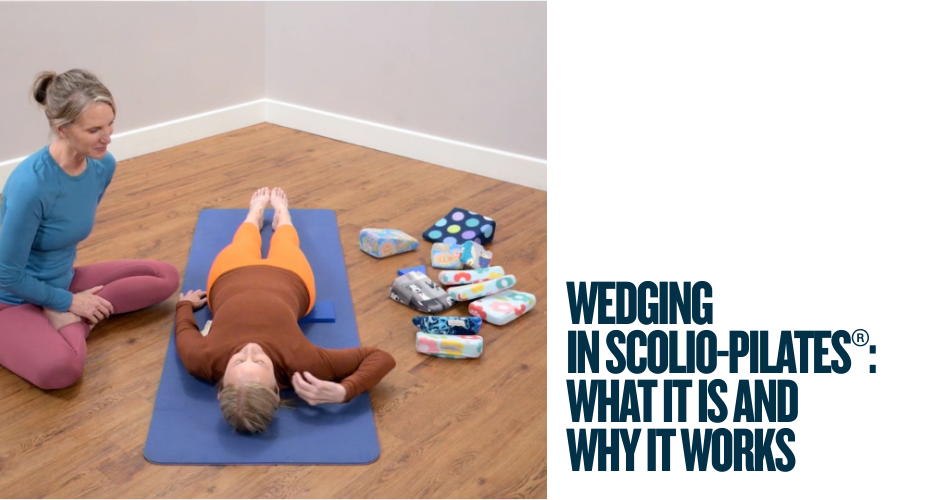
If you’ve had a session with a Scolio-Pilates® practitioner, chances are you’ve found yourself lying on a mat surrounded by small, precisely placed foam shapes. Maybe you wondered what they were doing there, or whether they were really making a difference. If you’re a movement or rehabilitation professional, you might be curious about the science behind a tool that looks deceptively simple.
The Origin: A Practical Problem
The Scolio-Wedge was not designed as a product from the outset. It was created to solve a hands-on problem—or a “hand” problem. I was simply running out of hands when I was trying to provide tactile cues to a scoliosis client.
When working with scoliosis clients, a practitioner needs to support multiple correction points at the same time — lumbar rotation, thoracic rotation, the pelvis, the shoulder girdle. Two hands are not enough. Early in the development of the Scolio-Pilates® method, practitioners found themselves improvising with a leg, a foot, or the back of a knee to act as a third or fourth hand. When that became impractical, the solution was foam, cut by hand at a kitchen table.
What began as a workaround became one of the most essential tools in the Scolio-Pilates® system: the Scolio-Wedge.
The Top 3 Scolio-Pilates® Wedges
The Scolio-Pilates® system includes a range of wedges, each designed for a specific purpose and position. Three stand out as foundational tools that practitioners and clients return to again and again.
1. The Scolio-Fit: The Scolio-Fit is a supine wedge designed for areas of the body that are lighter or require a more precise correction without obstructing movement. The Small-Fit is particularly well-suited to the thoracic region, and the lower-profile wedge allows the arms to move freely during exercises without the wedge shifting or getting in the way. It is also the preferred choice for smaller bodies or curves that do not require the deeper support of a Restorative wedge.
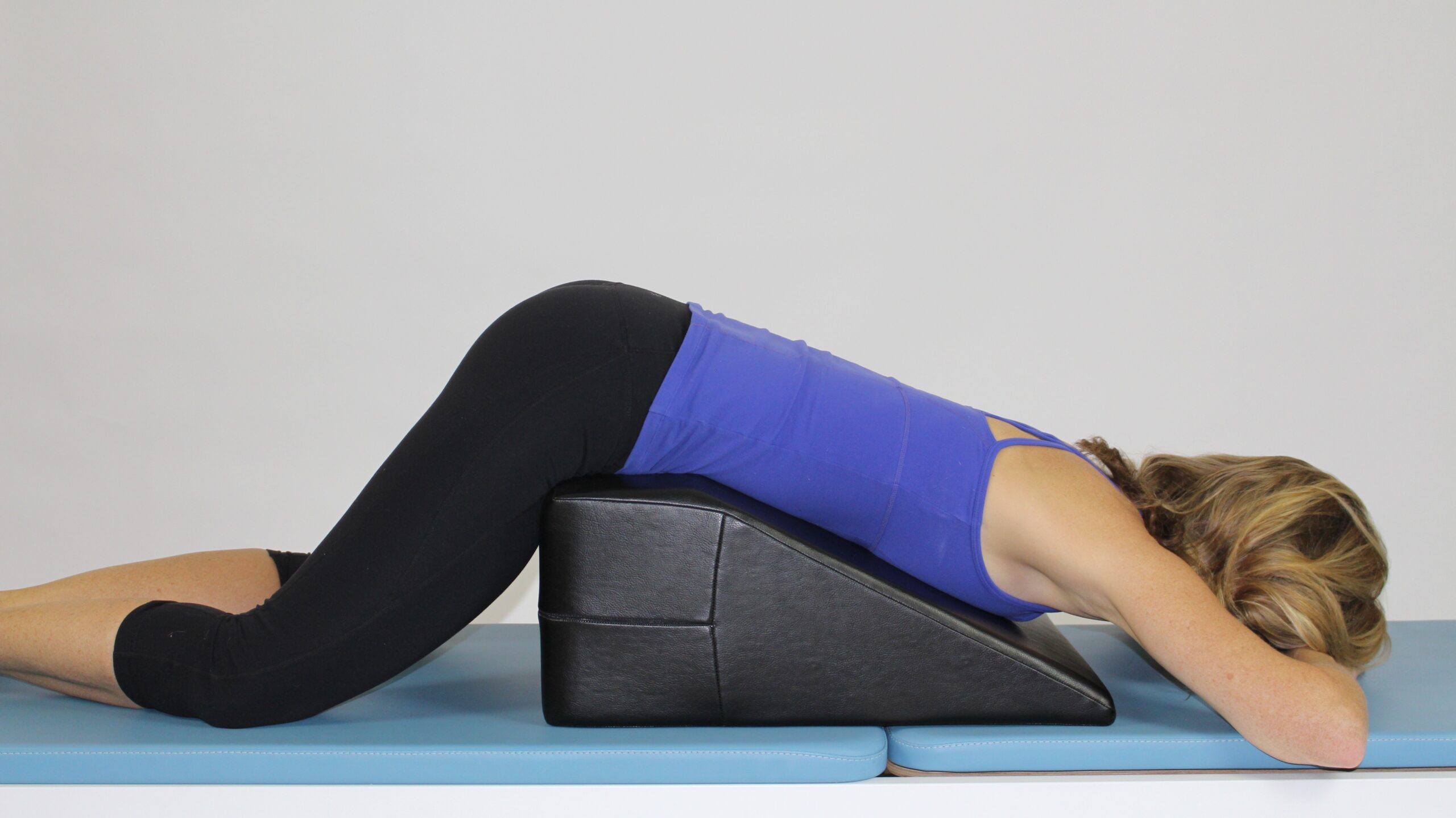
2. The K-Wedge: The K-Wedge offers a simple, supportive way to create spinal length and gentle elongation using gravity and your own body weight. Its inclined design invites you to soften, breathe, and strengthen from within—helping your spine feel longer, lighter, and more organized. As your spine passively moves towards neutral, using gravity, the shape of the diaphragm improves as well. Now, each breath you take strengthens the new-found length and more neutral position of the spine.
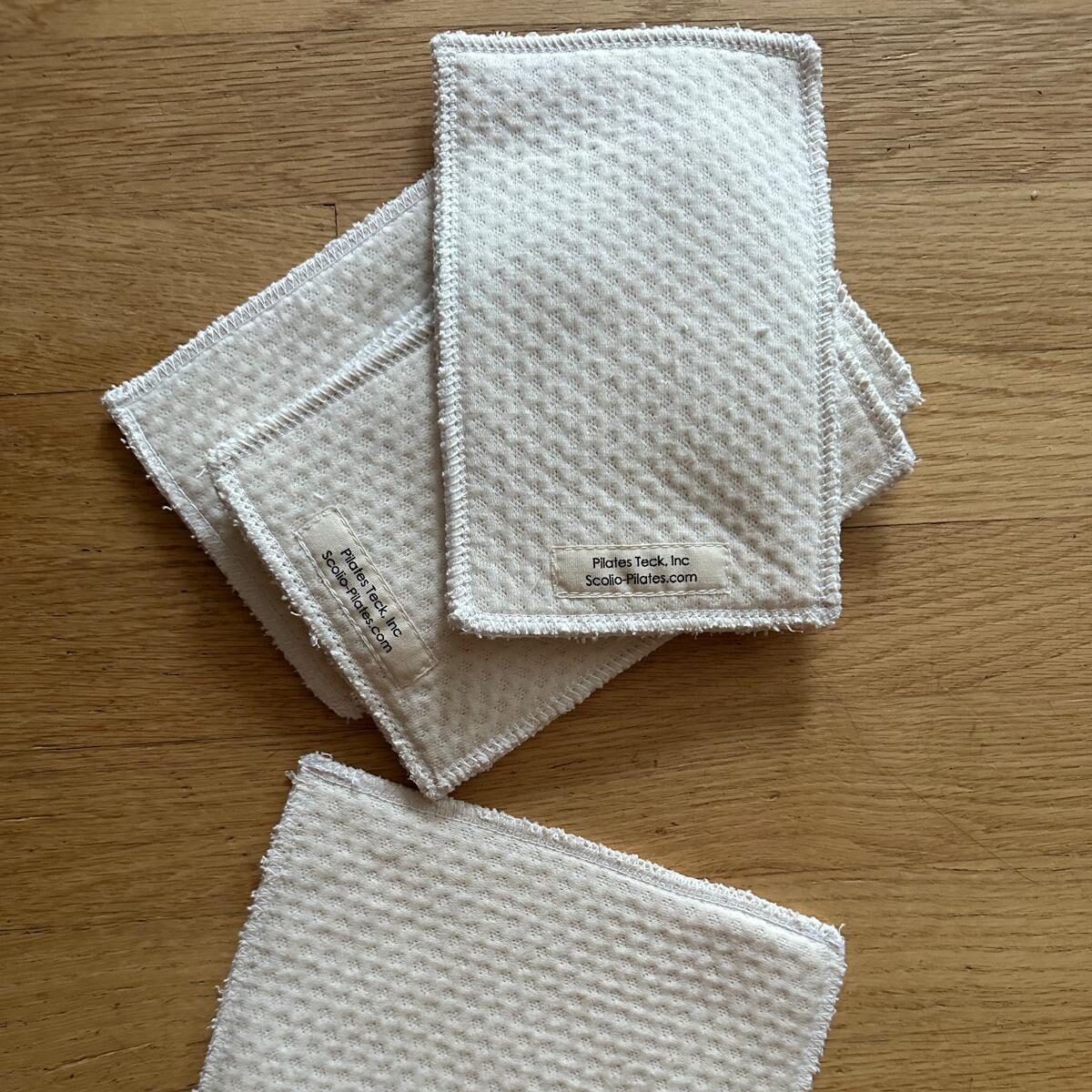
3. The Scolio-Cottons: Scolio-Cottons are soft, organic cotton alignment pads designed to support very gentle, intentional changes in scoliosis-specific movement and posture work. They offer subtle input—just enough to help the body sense position, improve awareness, and explore a more organized alignment without forcing or correcting. They are the perfect place to start when you are wondering, “Which wedge?” The Scolio-Cottons can be stacked, folded, or even rolled into a hot-dog-bun shape to assist with all levels or rotations from the pelvis, lumbar, thoracic and base of the neck—the proximal thoracic.

What a Wedge Does
Scoliosis is a three-dimensional change to the spine. It is not simply a curve to the left or right — it involves rotation, translation, and a cascade of structural compensations from the feet to the skull. Every breath, every step, and every moment of sitting reinforces the shape the body has adapted to. Creating change requires offering the body a different experience, repeatedly and consistently, in a way the nervous system can begin to accept as normal.
The Scolio-Wedge serves that function.
Passive Correction
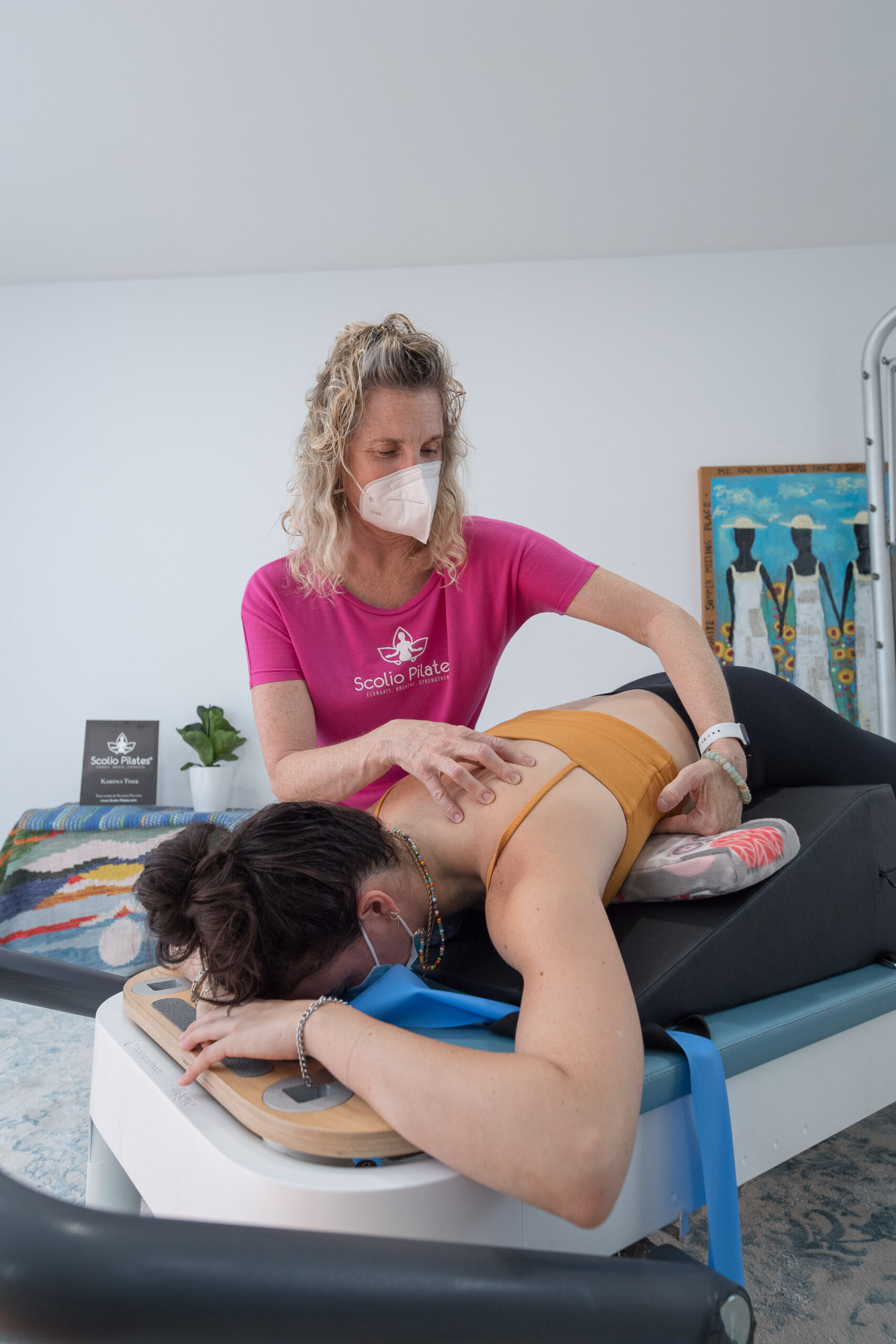
When a Scolio-Wedge is placed under a convexity — a rotated section of the spine — it offers the spine a gentle pathway toward neutral without requiring active effort from the client. The body, however, is never truly still. Every breath moves the diaphragm. Every heartbeat pulses through the tissues. Spinal fluid is in constant motion. Arteries are contracting. Nerves are firing.
All of that constant internal activity works with the wedge. As the body rests in the corrected position, the soft tissues — connective tissue, fascia, muscles — begin to reorganize around the improved alignment. The bones (the statics) and the soft tissues (the dynamics) gradually settle into a new relationship with one another.
This is passive correction. It is effective precisely because it works with the body’s own motion rather than against it.
Active Correction
Passive correction is the starting point, not the destination. Once the spine is supported in a more neutral position, the next step is to ask the client to actively lift away from one wedge while maintaining all other corrections.
The question becomes: can the ribs lift away from the thoracic wedge? Can the other side find its way to sink softly into the hollow –created by the concavity and a lack of wedge.
This progression is where the real training begins. The wedge acts as a tactile reference point — an anchor that teaches the body where neutral is, so the neuromuscular system can gradually learn to find and hold that position independently. Over time, the corrected alignment becomes less effortful and more automatic. And because you will understand your own wedging, that process of retraining continues well beyond the studio.

Wedging as a Daily Practice
One of the most significant aspects of the Scolio-Wedge system is its portability. You are taught your own personal wedging as part of your home program, because the care of a scoliotic spine cannot be limited to sessions in the studio or clinic.
Many Scolio-Pilates® clients sleep with their wedges in place. Others use a C-Wedge behind the back during long drives, turning commute time into passive correction time rather than accumulated strain. The wedge system extends the reach of the practitioner into the daily life of the client, increasing the total time the spine spends in a healthier position.
Relevance for Professionals
For Pilates instructors, physical therapists, and other movement or rehabilitation professionals, the Scolio-Wedge system offers something that manual therapy alone cannot fully provide: a way to hold a three-dimensional spinal correction while simultaneously freeing the practitioner to teach, cue, and layer additional work. Think of the wedges as gaining one extra hand for every wedge that is needed.
Wedge placement is position-specific and curve-specific. The protocol for supine differs from prone, which differs from side-lying, seated, and quadruped. There are no universal rules — each client’s curve pattern determines where the wedges are placed and how they are used. Learning the subtleties of placement requires dedicated study and supervised clinical hours. The wedges are only as effective as the assessment that precedes them.
Used correctly, the Scolio-Wedge functions as a bridge between passive support and active neuromuscular retraining — between where the spine currently is and where the treatment is guiding it.
The Broader Purpose
Scolio-Pilates® is grounded in the understanding that every breath either confirms the current shape of the spine or becomes an opportunity for change. The wedges shift that balance. They offer the body a better alignment, hold it there long enough for the nervous system to register it, and then invite active participation to consolidate that change.
A foam wedge, cut by hand at a kitchen table with a basset hound looking on for the sewing of the covers, has become a cornerstone tool in a method that has helped thousands of people living with scoliosis experience less pain, improved function, and a clearer sense of what a more neutral spine feels like.
Authorized Scolio-Pilates® Practitioners receive training in wedging, assessment, breathing techniques, and scoliosis-specific exercise across three modules of professional study. To find a practitioner or explore the training pathway, visit scolio-pilates.com.