
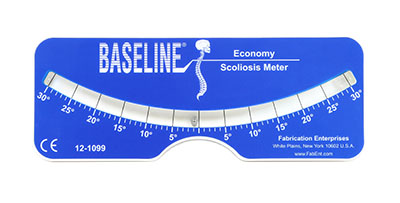
Description
For Professionals:
The scoliometer is a key assessment tool used during the Adams forward bend test to quantify angle of trunk rotation (ATR) and identify rotational asymmetries of the scoliosis spine in the transverse plane. While its measurements do not correlate directly with Cobb angle—which reflects coronal plane curvature severity—the scoliometer provides essential information about rotational components that influence rib positioning, breathing mechanics, and movement strategy. Accurate placement, reading, and interpretation of the scoliometer require specific training and clinical reasoning. Developing proficiency with this tool is a core competency taught in Scolio-Pilates® Module 1 and is considered essential for practitioners seeking to assess, cue, and apply scoliosis-specific movement strategies with precision and consistency.
For Clients:
The scoliometer is a simple tool we use to better understand how a scoliosis spine is rotating. It’s most often used during the Adams test, also called the forward bend test, where the spine’s natural asymmetries are easier to see and feel.
Think of a scoliometer like a small level you might use at home to check if a shelf is straight. Instead of measuring “level,” it helps us notice rotation in the rib cage or trunk—something known as the angle of trunk rotation (ATR). It’s quick, gentle, and completely non-invasive.
The numbers on a scoliometer can be a bit confusing, so it’s important to know what they do and don’t mean. These measurements do not represent the Cobb angle that doctors use to describe the size or severity of a curve. The Cobb angle looks at the spine from the front or back, while the scoliometer measures rotation—how the spine twists—when you bend forward.
Together, these tools give us different pieces of the picture, helping us understand how a scoliosis spine is moving and where support may be most helpful.



There are no reviews yet.