Where Should I Begin?

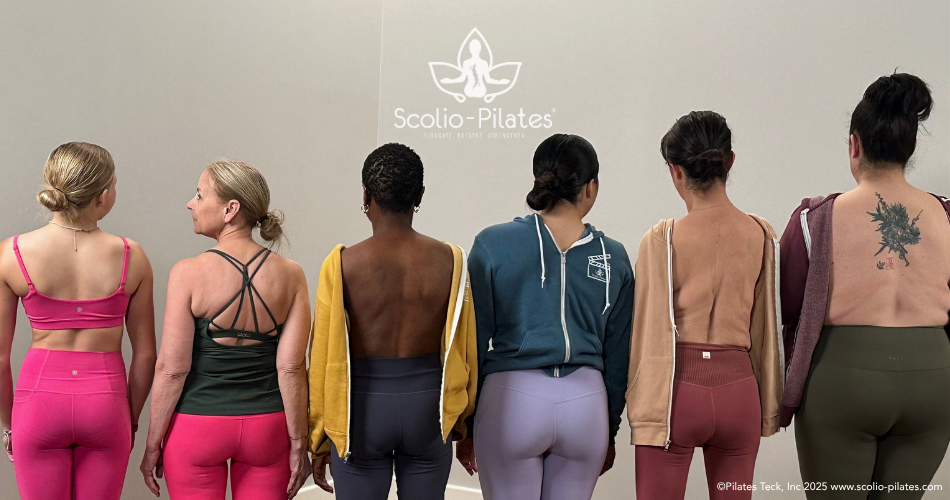
Six people of different ages and body types standing with their backs to the camera, showing a range of spine shapes, with with Scolio-Pilates® logo

Find Your Starting Point

Scoliosis doesn’t arrive the same way for everyone.

Some of you are a few weeks past a diagnosis and still catching your breath. Some have known your curves for thirty years and simply want somewhere good to put that knowledge. Some of you are fused. Some are in pain and running out of ideas. Some are here for your child, or for a client who walked into your studio last week.

That’s why there’s no single first step we can point everyone toward. What helps most depends entirely on where you’re standing right now.

So here are six moments in a journey, each in the words we hear most often. One of them is probably where you are right now.

      • “I’m a movement professional, and I have a client with scoliosis.”
      • “I was just diagnosed, and honestly? I’m overwhelmed.”
      • “I know my curves. I just want to move more.”
      • “I’m fused, and I’m never sure what applies to me.”
      • “I’m in pain, and I don’t know what else to do.”
      • “My child was just diagnosed.”

“I was just diagnosed, and honestly? I’m overwhelmed.”

Deep breath. Diagnosis day has a way of making the whole future arrive at once, and it hasn’t. You have time, you have options, and you don’t need to understand everything this week. Scolio-Pilates® The Foundation is where to begin: it teaches you your own curve pattern and what elongation actually feels like in your body, and everything else builds on it. Add a set of wedges so the work is possible at home, and Take Action for Scoliosis when you’re ready to put it into practice. Then put eyes on it. A practitioner who knows curves will tell you in one session what months of reading can’t.

“My child was just diagnosed.”

Nobody hands you a manual for this, and the internet at two in the morning is not your friend. Your child is still your child: still able to move, play, grow, and be a kid about all of it. Patty’s webinar on children and scoliosis is the place to start, from someone who works with young spines every day and can tell you what movement does alongside whatever else the medical path involves. Then find apractitioner experienced with children who can walk it with you.

“I’m in pain, and I don’t know what else to do.”

You’ve tried things. Some helped a little, some didn’t, and you’re tired in a way that’s hard to explain to people who haven’t been here. Start with the Understanding Pain webinar, because knowing what your nervous system is actually doing changes what you’re able to do about it. That’s not a consolation prize; it’s the most useful place to begin. The K-Wedge gives your body relief it can feel while you work, and a practitioner will adapt with you rather than hand you a fixed program.

“I’m fused, and I’m never sure what applies to me.”

More than you think, friend. So much more than you think. A fused spine still moves, still breathes wide into the ribs, still finds length above the fusion, below it, and through the breath itself. The Fusion Series exists for exactly this question: what applies, what changes, and how to work with the mobility you have. Wedges support the segments doing the adapting, and Scolio-Pilates® On Demand keeps you practising between sessions. Find a practitioner who can tailor it to your fusion and your levels rather than to a general spine.

“I know my curves. I just want to move more.”

You’ve done the learning. You know your tide pools from your sand dunes, and what you want now is somewhere to put all of it without rebuilding your schedule around it. Scolio-Pilates® On Demand is your home base: the full class library, on your time, in whatever you happen to be wearing. When you want to work harder, K-Fit is waiting, and the Balanced Body Take Action and Strength classes take you from correction into real capability.

“I’m a movement professional, and I have a client with scoliosis.”

Welcome. You don’t have to become a scoliosis specialist overnight, but you do need to know what you’re looking at and, just as importantly, what not to do. A curved spine isn’t a straight spine with a bend in it; it’s a three-dimensional pattern with its own logic, and once you can read it your existing skills become far more useful than you’d expect. The Modules are the training pathway, and the enhancement classes go deeper on the questions that come up in real sessions.